
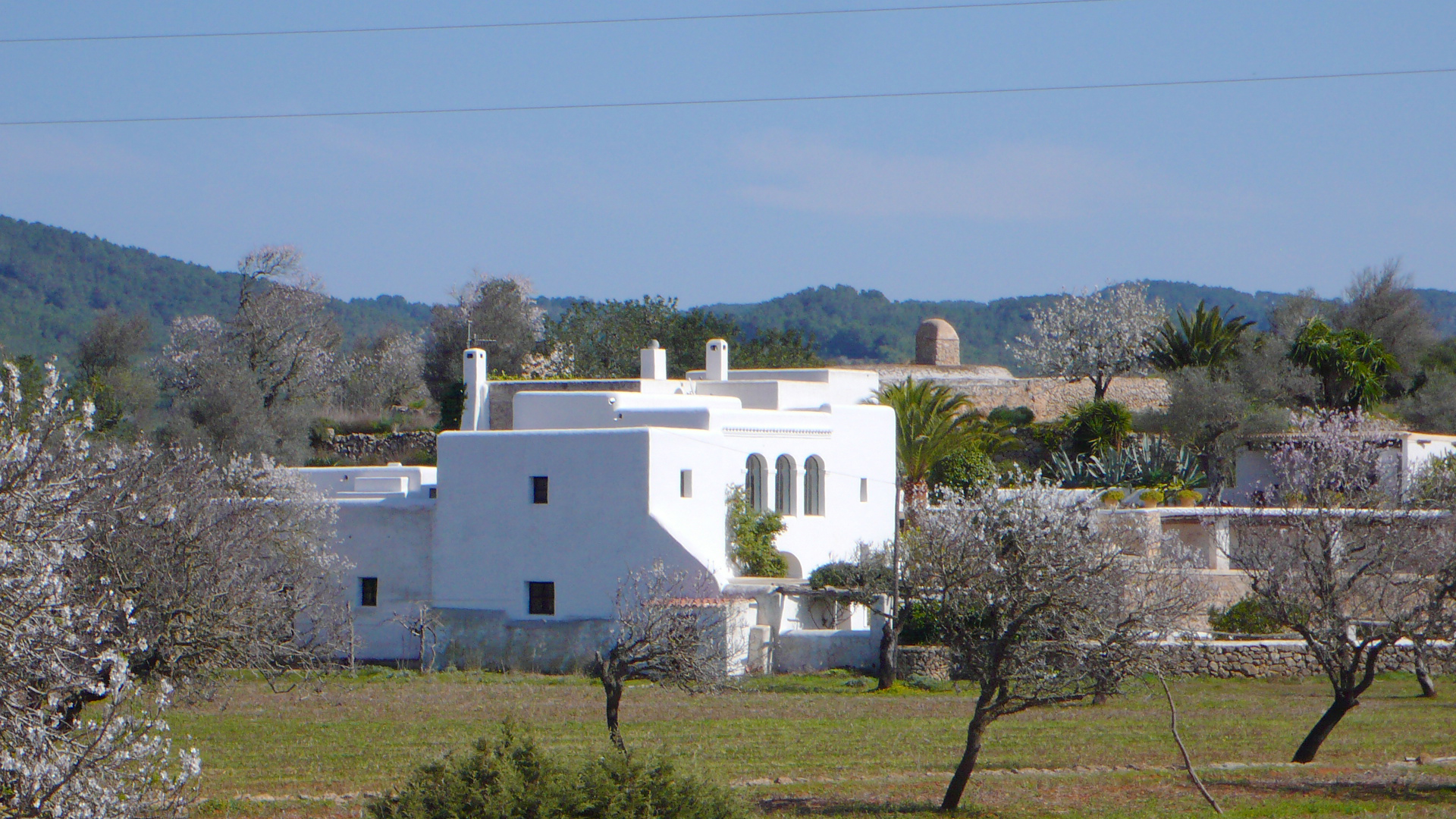
For most people, talking about Ibiza means talking only about the coast, the coves and the clubs. But the real island, the one our guests discover when they land at a rural villa far from the noise, lies inland. If you’re wondering which villages to visit in Ibiza to truly understand how life works here, the answer is in a handful of whitewashed settlements scattered across the interior, where time is measured by the local farmer’s calendar rather than by the latest DJ set. We’ve been guiding travellers around these villages for years and, according to our guests, they’re always the surprise of the trip.
Why the inland villages are the most authentic Ibiza
Ibiza’s villages weren’t built facing the sea. They went up inland, away from the coast, to protect their inhabitants from the pirate raids that swept the Mediterranean between the 16th and 18th centuries. That explains their compact layout, their fortress-churches and the defensive feel underneath the whitewash. It also explains why these places remain so quiet today: they were never built for tourism in the first place.

Ibiza is split into five municipalities — Sant Joan de Labritja, Sant Antoni de Portmany, Sant Josep de sa Talaia, Santa Eulària des Riu and Eivissa — that together cover these rural settlements. Each one keeps its white parish church, almost always 16th- or 17th-century and listed as a Cultural Heritage Site, and a small square that still works as the real social centre. That structure, almost untouched for four centuries, is what makes walking through these villages feel like crossing layers of Ibizan history on foot. Nothing here is staged for visitors: it simply keeps running the way it always has.
The essential Ibiza villages you have to visit
Santa Gertrudis de Fruitera — the gastronomic heart
Santa Gertrudis is probably the most visited village in the interior, and for good reason. Its whitewashed square, watched over by the 18th-century parish church, packs in a surprising density of traditional restaurants, art galleries, antique shops and local-produce stores. It’s the village that best balances authenticity and visitor offer without losing its character.
- Bar Costa: The cured-ham sandwich with Ibizan tomato has been an institution since 1933. Shared tables and local art on the walls.
- Art galleries: More than a dozen within a 200-metre radius, with exhibitions rotating every season.
- Santa Gertrudis church: 18th-century construction with vaulted sacristy and simple bell tower. Usually open in the mornings.
- Producers’ market: Saturday mornings in the square, with Ibizan cheese, herbs and artisan cured meats.
- Strategic location: Geographic centre of the island, 15 minutes by car from both the north and Eivissa.
Sant Joan de Labritja — the hippie-chic north
Sant Joan is the head village of the northernmost municipality and keeps the rural Ibizan spirit completely intact. Its 18th-century white church, austere and luminous, presides over a tiny square where one of the most authentic markets on the island sets up every Sunday morning: medicinal herbs, clothes, handmade jewellery, garden produce and live music on the terrace of the village bar. Getting there means driving up secondary roads through pinewoods, and that is part of the charm. If your trip includes exploring the north, this village is an obligatory stop.
Sant Carles de Peralta — bohemia and the Las Dalias market
Sant Carles is inseparable from Las Dalias, the longest-running hippie market in Ibiza. It has been operating since 1985 every Saturday from March to November, and on Wednesday and Monday evenings during the summer. But the village itself deserves a visit beyond the market: its 18th-century white church, Bar Anita — a stop for generations of travellers since the 1960s — and the bohemian atmosphere that has soaked into the place for decades make Sant Carles a case apart. It’s the village where you can most clearly feel that Ibiza has always been a refuge for people looking for something different.
Sant Miquel de Balansat — fortress-church and Benirràs
The church of Sant Miquel is one of the most impressive on the island: a 16th-century whitewashed fortress, built on a hilltop to defend the village from pirates, with walls, a watchtower and views all the way to the sea. It’s listed as a Cultural Heritage Site and opens in the mornings. From Sant Miquel a short drive takes you down to Cala Benirràs, famous for the drumming session that gathers there every Sunday at sunset in summer. Combining a historic village with a bohemian cove makes this one of the most complete day plans in the north.
Other villages worth visiting: Sant Josep, Sant Llorenç, Jesús, Sant Mateu, Sant Agustí
The list doesn’t end with the four headline names. Sant Josep de sa Talaia, in the southwest, is the natural base for climbing Sa Talaia, the island’s highest peak at 475 metres, and concentrates several quality local-cuisine restaurants. Sant Llorenç de Balàfia, deep in the interior, is one of the quietest villages and home to a traditional payés winery worth a visit. Jesús, just outside Eivissa, surprises with a 15th-century Gothic-Flemish altarpiece in its church — one of the most valuable artistic pieces in the Pitiusas. Sant Mateu d’Albarca hosts every November the Festa des Vi, a country-wine festival that gathers producers from across the island. And Sant Agustí des Vedrà, in the centre-west, is famous for its church, its stone-paved square and Bar Berri, an Ibizan classic with a daily menu and tables in the square.
If you want to explore these villages at your own pace, without depending on public transport or fixed schedules, the easiest option is to base yourself in your own house. Our rural villa rentals scattered across the interior give you the perfect base to cover several villages in a single day and return to a quiet place every evening.
Find your perfect villa in Ibiza

How to plan your village route: days, transport and best season
To see the essential inland villages without rushing you’ll need three full days, broken down like this: one day for the north (Sant Joan, Sant Miquel and the drive down to Benirràs), another for the centre (Santa Gertrudis, Sant Mateu, Sant Llorenç) and a third for the east and southwest (Sant Carles with Las Dalias, Jesús, Sant Josep, Sant Agustí). A car is essential: public transport in the interior is very limited and many villages fall outside the regular bus lines.
The best time for this route is May to June or September to October. The weather is good, restaurants are open, the markets run at full pace and you won’t run into crowds. July and August work perfectly well if you don’t mind heavier footfall, especially in Santa Gertrudis and Las Dalias. And if you come in winter, the villages keep their normal life going: in February the almond trees of Santa Agnès in bloom turn the interior into an unreal landscape. You can find more ideas in our Ibiza experiences guide, where we set out routes and recommendations area by area.
Need more information?
Get in touch and we’ll advise you with no obligation.
Frequently asked questions about Ibiza villages
- How many Ibiza villages do you need to visit to know the island well?
- With four or five carefully chosen villages — Santa Gertrudis, Sant Joan, Sant Miquel and Sant Carles as a minimum — you already have a solid sense of the interior. If you have more days available, add Sant Josep, Sant Mateu and Jesús to round out the picture. The island is small: in a week you can cover them all without rushing and still combine village, cove and restaurant every day.
- Is Dalt Vila one of the Ibiza villages?
- Not exactly. Dalt Vila is the walled old town of Eivissa, the capital, listed as a UNESCO World Heritage Site since 1999. It isn’t a rural village but a medieval urban quarter with a cathedral, museums and Renaissance walls. It’s an essential visit, but it belongs to a different category: urban culture as opposed to the rural, agricultural character of the inland villages.
- Which Ibiza village is best for traditional Ibizan food?
- Santa Gertrudis and Sant Josep concentrate the best traditional Ibizan cuisine with local produce: bullit de peix, sofrit pagès, flaó and Ibizan sobrasada. In Sant Mateu, during the Festa des Vi in November, you can taste payés wines straight from the producer. In any inland village, the daily set menus still serve traditional recipes at reasonable prices, well away from the tourist tier of the harbours.
- Do the village markets run all year round?
- Some do and others are seasonal. Las Dalias in Sant Carles operates on Saturdays from March to November. The Sant Joan market runs on Sunday mornings almost all year, although with fewer stalls in winter. The Santa Gertrudis market is weekly from March to October. Before planning a specific visit it’s worth confirming dates, especially between November and February.
- Which rural villa is best for reaching the inland villages?
- A central location on the island — areas around Santa Gertrudis, Sant Mateu or Sant Llorenç — lets you reach almost any village in under 25 minutes by car. If you’re more interested in the north, a villa near Sant Joan or Sant Miquel is ideal for combining villages and northern coves like Benirràs or Cala d’en Serra. We can help you choose based on the villages you want to prioritise on your route.

The Ibiza villages that stay with you when you go home
What sets Ibiza’s villages apart isn’t a checklist of spectacular monuments or an overwhelming artistic heritage. It’s something subtler: the light hitting a whitewashed church at seven in the evening, the silence that settles over a square when the sun goes down, the nod from the farmer watering his vegetable patch at the side of the lane. That Ibiza isn’t being marketed at you — it simply waits, in every one of these inland villages.
If you’re coming to the island looking for the side that doesn’t appear in the club features, at Ibiza Rural Villas we’ll help you find the perfect base to discover them at your own pace. Tell us which villages interest you most and we’ll recommend the villa that fits your route best.
 Guías de Alojamiento
What to pack for your Ibiza holiday
Packing for Ibiza might seem straightforward — sun, beach, light clothing — but there are details that make the difference...
16 Mar 2026 Guías de Alojamiento
How to get to Ibiza from mainland Spain and Europe
16 Mar 2026 Guías de Alojamiento